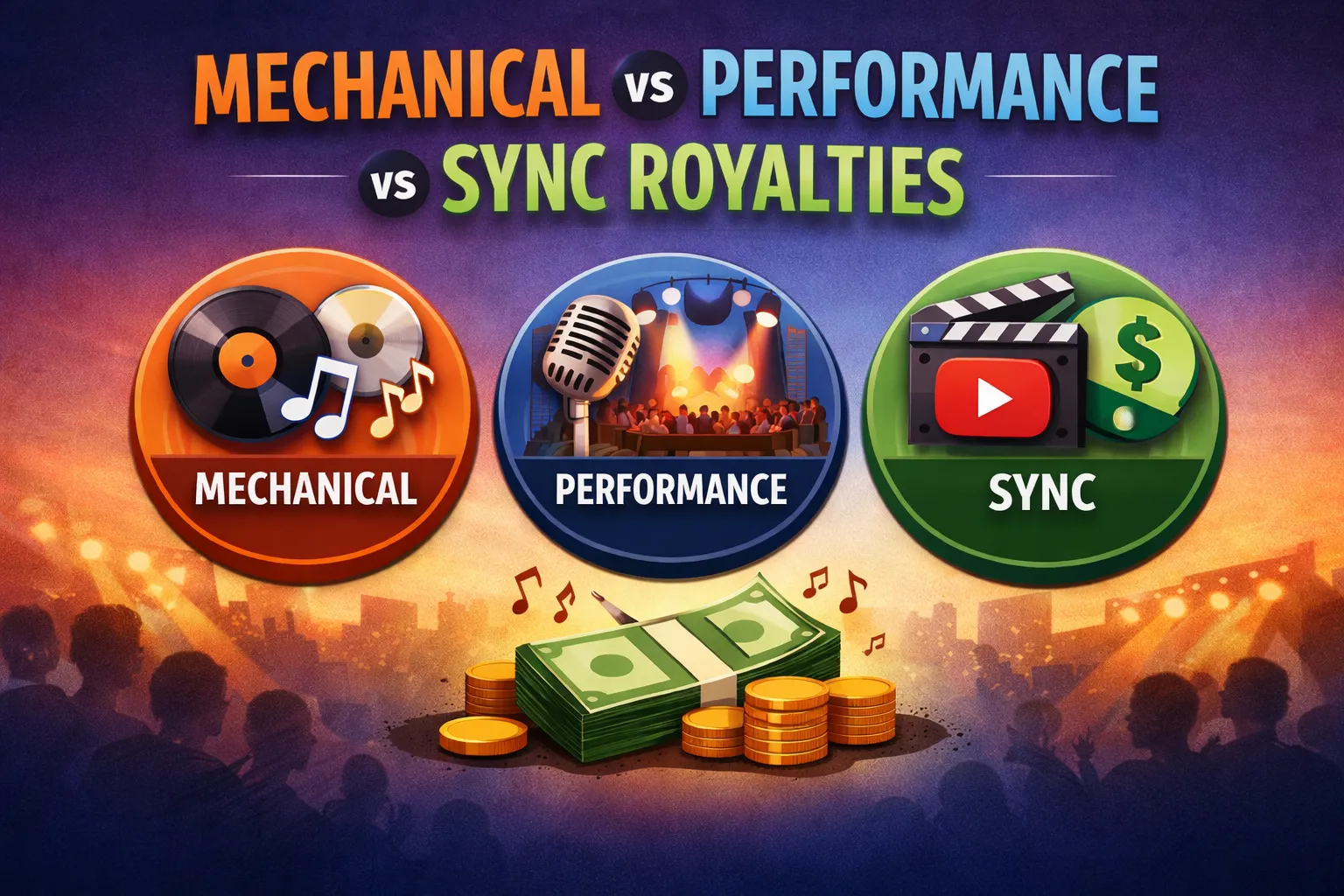
Mechanical vs Performance Royalties
Mechanical, performance, and sync royalties come from different uses of your song. This plain-English guide explains how each works, who collects them, and why YouTube has created a new sync-like royalty most songwriters miss.
Mechanical vs. Performance vs. Sync Royalties (Plain-English Guide for Songwriters)
If you’ve ever looked at a royalty statement and thought “Why are there so many different types of royalties?” you’re not alone.
Mechanical royalties, performance royalties, and sync royalties all come from different uses of the same song, and they’re collected by different organizations. Understanding the differences is key to knowing who pays you, when you get paid, and what you might be missing.
This guide breaks it all down in clear, simple terms for songwriters, artists, and small publishers.
First Things First: Two Copyrights in Every Song
Before talking about royalties, it helps to understand what actually gets paid.
Every song has two separate copyrights:
- The Composition
- Lyrics and melody
- Owned by the songwriter(s) and publisher(s)
- The Sound Recording (Master)
- A specific recorded version of the song
- Owned by the artist or record label
This article focuses mostly on publishing royalties, which come from the composition.
What Are Performance Royalties?
Performance royalties are earned when a song is played publicly.
“Public performance” includes much more than concerts.
Examples of Public Performances
- Radio (AM/FM)
- TV shows, movies, commercials
- Streaming (Spotify, Apple Music, Pandora)
- Restaurants, bars, stores, gyms
- Live shows and festivals
- YouTube videos
Who Collects Performance Royalties?
- PROs (Performing Rights Organizations) such as:
- ASCAP
- BMI
- SESAC
- Outside the U.S., these are often called CMOs
These organizations license music to users and pay royalties to:
- Songwriters (writer’s share)
- Publishers (publisher’s share)
Important Detail Most People Miss
- AM/FM radio pays songwriters, not recording artists
- Digital radio (like Pandora) pays both, but through different systems
- Performance royalties are typically split:
- 50% writer
- 50% publisher (in the U.S.)
What Are Mechanical Royalties?
Mechanical royalties are earned when a song is reproduced.
Originally, this meant physical copies. Today, it mostly means streaming.
When Mechanical Royalties Are Earned
- CDs, vinyl, cassettes
- Digital downloads
- On-demand streaming (Spotify, Apple Music)
What Does Not Generate Mechanical Royalties
- Non-interactive streaming (Pandora, internet radio)
- Terrestrial radio
Who Pays Mechanical Royalties?
- Record labels
- Digital streaming platforms
Who Collects Them?
In the U.S.:
Outside the U.S.:
- Mechanical Rights Organizations (MROs)
- Collective Management Organizations (CMOs)
Key Thing to Know
To collect mechanical royalties, you must have:
- A publisher
- A publishing administrator
- Or your own publishing entity
Without one, money can sit unclaimed.
Streaming: Why It Pays Both Performance and Mechanical Royalties
Streaming didn’t exist when copyright laws were written, so it’s treated as a hybrid.
Every stream on Spotify or Apple Music generates:
- Performance royalties (collected by PROs)
- Mechanical royalties (collected by the MLC or similar agencies)
That’s why streaming royalty statements feel confusing. They’re pulling from multiple buckets.
What Are Sync Royalties? (And Why YouTube Changed Everything)
Sync royalties are traditionally earned when a song is paired with visual media.
But today, this category has quietly evolved into something much bigger, and much more YouTube-specific.
Historically, sync meant:
- TV shows
- Movies
- Commercials
- Trailers
- Video games
These uses required a synchronization license, usually negotiated directly between the producer and the publisher.
The New Reality: YouTube as a Sync Platform
YouTube has effectively created a new, hybrid form of sync royalty that many songwriters don’t even realize exists.
Every time your song appears in a YouTube video:
- It is synchronized to visual content
- It is reproduced (mechanical)
- It is publicly performed (performance)
This means a single YouTube video can generate multiple publishing royalties at once.
How YouTube Micro-Sync Works
- Triggered by audio + visual use
- Applies to user-generated content, not just films or ads
- Not negotiated song-by-song like traditional sync
- Often paid as usage-based revenue, not a one-time license fee
Because this system doesn’t look like traditional film or TV sync, it’s often:
- Misunderstood
- Misreported
- Or missed entirely by songwriters without proper publishing administration
Why This Matters
YouTube is now one of the largest sync-like environments in the world, even though most people don’t think of it that way. Treating YouTube publishing income as just streaming leaves money on the table.
Quick Comparison (Conceptual)
- Performance Royalties
- Triggered by public playback
- Collected by PROs
- Paid repeatedly over time
- Mechanical Royalties
- Triggered by reproduction
- Collected by mechanical agencies
- Dominated by streaming today
- Sync Royalties
- Triggered by audio + visual use
- Traditionally negotiated, but now heavily YouTube-driven
- Can be upfront, usage-based, or hybrid
Why Ownership Splits Matter
All publishing royalties are paid based on ownership percentages.
That’s why:
- Split sheets matter
- Publisher shares matter
- Accurate registrations matter
If splits aren’t agreed on and registered correctly, royalties can be delayed or lost entirely.
Why Many Songwriters Miss Money
Common reasons include:
- No publishing administrator
- Missing international registrations
- Unclaimed mechanical royalties
- Untracked YouTube usage
- Incorrect or incomplete metadata
Most missed income today doesn’t come from radio or CDs. It comes from digital platforms where the rules are still evolving.
Final Takeaway
Every time your song is:
- Played - performance royalties
- Reproduced - mechanical royalties
- Paired with video (especially on YouTube) - sync-related publishing income
These royalties are different, separately collected, and not automatic unless your publishing is properly set up.
Understanding how they work, especially in the YouTube era, is the first step toward making sure nothing slips through the cracks.